When Building Got Cheap, Distribution Became the Work
I closed my web development agency even though it was making money. AI tools made building easy — so I moved to distribution. Here's what that looks like.
Why I closed the agency
I used to run a web development service agency. It was going well. I was 19, work was coming in, and on paper there was no obvious reason to stop. On LinkedIn I put it bluntly: even after making lakhs, I closed it.
At the time that looked like a strange decision. From where I stand now, it was the logical one.
The web development industry was changing fast. As a service business, it was shrinking. Tools like Emergent can get a website built in a minute. That is not just faster delivery — it changes what a website is worth on its own.
The question the industry wasn't asking
You can get a website built in a minute. But what about distribution?
What is the point of a beautiful site if nobody visits it?
I had a feeling a lot of people would only understand this when it was already too late: after the launch, after the spend, after the silence. Building had become the easy part. Getting the right people to see the thing you built was the part nobody was solving.
So I pivoted. No more just building websites. I started focusing on distribution.
What the numbers actually looked like
I don't want to dress this up, because the honest version is more useful than the polished one.
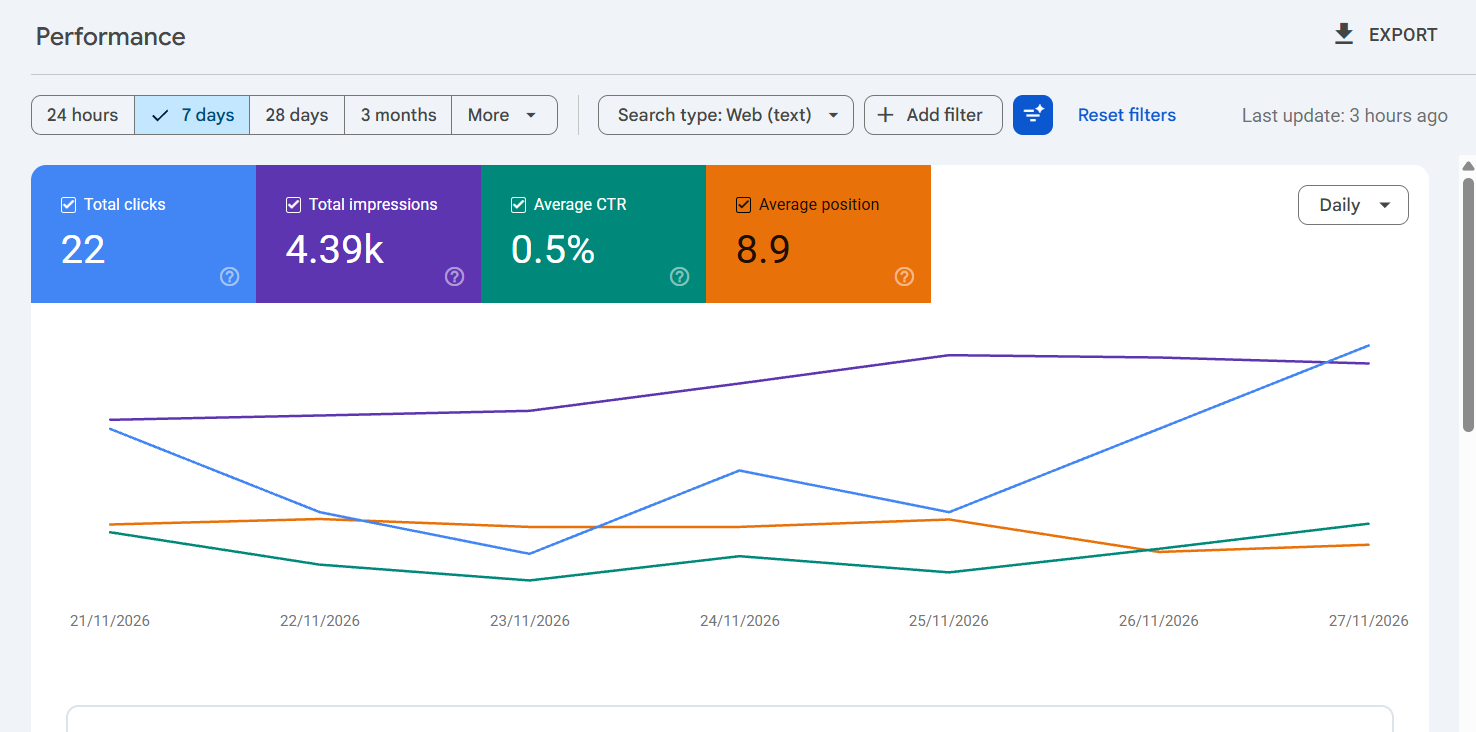
On SEO, I reported over 4,000 impressions a week and 20 clicks in 30 days. The impressions told me the site was being discovered. The 20 clicks told me I had a lot of work left — backlinks, click-through rate, better pages. Those are my own reported figures, not an independently audited result.
On Reddit, organic posting brought over 70 visitors a day to the site. Then Reddit banned me. That was a useful lesson: a channel you don't own can disappear in a day. Rented distribution is not an asset.
I'm still early. These are small numbers. I'm sharing them because I'd rather document the messy middle than wait until there's an impressive chart to show.
70% distribution, 30% building
My current split is simple: 70% distribution, 30% building.
That is not a formula I'm selling. It's where I'm putting my time, because building something and getting people to actually use it are completely different games.
When you build, you are solving for correctness. When you distribute, you are solving for attention and trust. The skills barely overlap. A clean codebase does not earn a single visitor on its own, and a good distribution strategy cannot save a product that breaks.
The mistake I see is treating distribution as the last step — something you do after the launch. It should shape the first decision: who is this for, where do they already spend time, and why would they care?
If you're hiring someone to build for you
This changes what a client engagement should look like.
If you're paying for a website or a product now, the question is not "can this person build it?" Plenty of people can. The question is "will the right audience ever find it?"
So when I build for a client, distribution is part of the brief, not an afterthought. Who is it for? Where are they? What would make them stop scrolling? How will we know if it worked? The build and the path to an audience have to be designed together, or you end up with a polished product and no one inside it.
I'm not going to claim a stack of case studies here. What I have is a clear point of view and a process I'm building in public.
If you're building a SaaS
This is the part I'd pay most attention to if I were shipping a product today.
The cost of getting something built has dropped. That means the bottleneck has moved. It's no longer "can I ship this?" — it's "can I get the first ten users, and then the next hundred?"
People are searching for exactly this. Google suggests queries like "saas distribution strategy", "how to get first customers saas" and "build in public". That's demand, not a guarantee — but it tells you what founders are actually worrying about.
The practical version: pick one channel you can sustain, show the work as it happens, and talk to users before you scale anything. Building in public isn't a growth hack. It's a way of making the distribution work visible while the product is still changing.
If you're evaluating founders
If you're an investor looking at early-stage companies, the product is only part of the picture. You're also betting on whether the founder can get it in front of people.
A public record of decisions — including the failed channels and the small numbers — is evidence. It's more useful than a polished deck, because you can see how someone thinks when things aren't going perfectly.
That's part of why I'm writing this down. Personal brand, for a founder, isn't about being famous. It's about having a verifiable trail of what you tried and what you learned.
What I'm not claiming
A few limits, because they matter:
- I'm not saying AI replaced web developers. Good engineering still matters — architecture, performance, integrations, the things that break at scale. The floor dropped; the ceiling didn't.
- I'm not saying distribution is a guarantee. The Reddit ban is a real cost, and 20 clicks is not a business.
- I'm not saying 70/30 works for everyone. It's my current allocation, and I'll change it if the evidence changes.
- The numbers above are self-reported by me, with the measurement details I actually have.
What's next
Ship fast. Fail fast. Learn. Ship again.
I'm documenting the whole thing here — longer essays on building and distribution, a founder journal for the short updates, projects for what's being built, and a now page for current focus.
If you're building something and you want someone who thinks about distribution while building, the contact page is open.